Tag: history

  • When Plans for the North East Region were actually done well compared with the inane drivel we get today

    I am currently writing a chapter entitled: The North East of England – Post-industrial Carboniferous Capitalism in a Birthplace of the Capitalocene for a book dealing with Mediating Industrial Change: Construction and Perception of Discourses about (De-) Industrialisation. My abstract indicates what I propose to deal with:

    This chapter will examine the trajectory of the North East (NE) of England towards a postindustrial character in terms of all of economic base, employment structure, cultural character, and political systems. The NE was a birthplace of industrial capitalism globally. It was where railway systems were first developed and was a major producer of coal, ships, iron and steel, and chemicals over about 250 years. It was also the location of major technological innovation. From the 1930s there were introduced a range of department two industries including clothing, textiles, and light electrical engineering so the region for the first time had a large industrial female labour force. In the 1960s over half of all employed adults were employed in production industries. In the 19th and early 20th centuries the region was one of the great industrial zones of the world and seen as such with. After the first world war there was a massive slump in  consequence first of UK economic policies and then of the global depression. During this  period national government began to intervene to resolve unemployment by diversifying the industrial base. These policies continued until the election of the Neo-Liberal Thatcher government in 1979. Since then, the region has lost the great bulk of its mining and  manufacturing base with profound implications for culture and identity. An important aspect in how the region was seen in the UK beyond itself was the development of a regionally based popular culture, particularly in television series, which documented lived experience. Although these presented a realist but positive version of place, at the same time national political culture began to frame the future of the regthe ion in terms of managed decline.

    As part of the background research for this I have been reading a range of public body documents produced during the 20th Century. Of particular value have been the Barlow Report  of the Royal Commission on the Distribution of the Industrial Population with the work done before WWII but published in 1940, the Hailsham report of 1963 on The North East a Progamme for Regional Devlopment and Growth, and two indigenous documents.   These are the the Northern Economic Planning Council’s Challenge of the Changing North (1966) and the Northern Regional Strategy Team’s Strategic Plan for the Northern Region(1977).  Reading these well researched and written documents is a pleasure. I had criticisms of the latter in the 1970s but the plan was entirely accurate in its description of the origins of the issues it was confronting. This is in marked contrast to the inane boosterism of  The Interim North East Local Growth Plan of March 2025 produced by nitwit Kim and her team. The abolition of the Government Office for the North East in 2011, apparently at the behest of the idiot LibDems in the coalition in favour of localism, eliminated the expertise and professionalism necessary for getting even a proper timeline of the past together as a basis for planning the future. It is worth noting that the Barlow report proposed elected regional governments but we lost our chance at that in 2004 when a poorly run campaign in favour of a North East Assembly (for too reliant on nobs and not on civil society) was done in by Dominic Cummins with the support of the UK branch of the wretched US Heritage Foundation and the refusal of Labour MPs and councillors, scared of losing their own power to a regional level, to campaign at all in support of it. So we have an apolitical body  which has to accommodate the idiots who thinks Farage has the answer to our ills and the good Tory friend of his business associates on Teesside (for a good summary of  Private Eye’s excellent coverage of this see https://northeastbylines.co.uk/region/teesside/teesworks-scandal-a-dark-tale-of-public-wealth-lost-and-private-gain/ ).  Consensus means no politics. Any decent Labour politician should be calling these bums out, not giving the portfolio responsibilities, but the system does not work that way.

    To be fair to nitwit Kim there was no evidence in Driscoll’s period as Mayor of “North of the Tyne” of any coherent informed planning and no sense of any political direction. His application for a Tyneside Freeport which would have involved suspension of trade union rights and environmental regulation over a wide stretch of his area was particularly inane but there was no political machinery for holding him accountable for this action.
  • Alex Niven: The North will rise Again. London: Bloomsbury £14 Hdbk 320 pages

    As I had a go at Niven in a recent post I thought I would post the review of his book which I wrote for North East Labour History Journal. This organization is now dominated by academics but for most of my long time in it, it had a large membership of people actually drawn from the industrial working class and who had worked in the world it addressed. The editorial board rejected this review on the grounds that it was “uncomradely”. I never knew that reviews were not allowed to criticize. Anyhow here it is and I stand by every word,

    Niven, a  ‘ leading voice on Northern identity and culture’ (Blurb for a Royal Society Event in York 2022), has a presence in the London Media. The book was extensively reviewed, not least in the Financial Times. It mixes personal memoir, literary criticism, weak history and a weaker account of Northern culture. He addresses the whole of the North but with a focus on the NE which I will follow in this review. The historical errors are trivial but if we don’t know our past we are damned to repeat it. For example, the Tyne Wear Metro was not the product of Dan Smith, far too much influenced by road engineers, but of Tyne and Wear County Council in the 1970s. Dan was an atypical product of machine Labour politics in the 60s. Far more representative was the vile crook, back-handy Andy Cunningham. That matters because the alliance of the local Labour machine with a right wing national party, now far to the right of Wilson et al., is back– witness the attempt to bar Driscoll from standing for NE Mayor. The 1970s Met Council was a progressive force but Blair (who to be fair Niven detests) did nothing to revive that level of governance.

    Niven focuses on high culture, especially on Bunting’s Briggflats. No mention of popular middle brow culture – When the Boat comes in, Whatever happened to the Likely Lads, plays from Live Theatre, especially Tom Hadaway – keep going –  so a literary critique rather than cultural study. If Niven had paid some attention to say the Likely Lads trajectory he would have engaged with lived experience, in the NE from the affluent 60s – see Pearson’s Sex, Brown Ale and Rhythm and Blues -towards the present. He might have understood the importance of the Elm Lodge housing estates. Niven has claimed to have returned to his native city on his appointment at Newcastle University. He didn’t. He grew up in the South Tyne Valley, the child of two blow-in educational professionals (both of working class origins and his London Irish mother could have put him right on the nature of the outer South East population which he gets badly wrong). He blew out to the music scene and to a higher education in London and Oxford before he blew back. He has no lived experience of North Eastern industrial working class life and no family background in it. That shows in what he writes.  Niven’s heart is in the right place but his head is away with the fairies and his representation of us to others is flat out wrong. 

    David Byrne

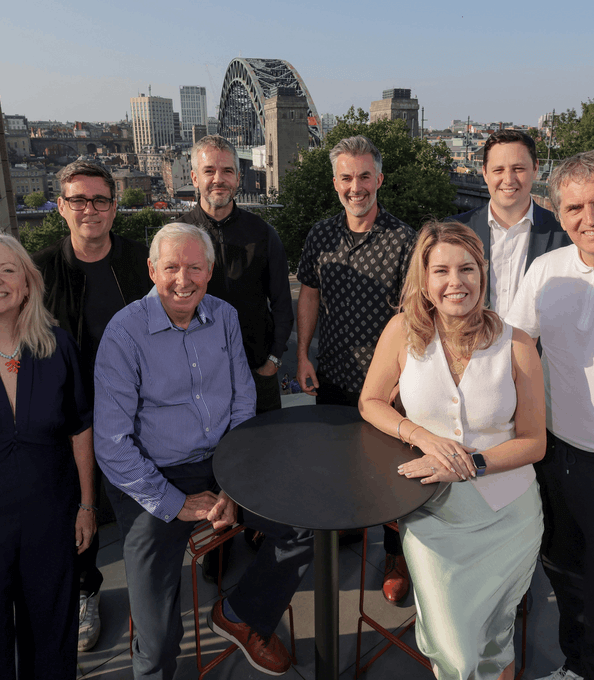
  • Mayor Kim McGuinness brought together Northern Mayors to set out a vision for a united ‘Great North’

    The image says it all. A picture is worth a thousand words. It shows seven of the North of England’s combined authority mayors, including Tees Valley mayor Ben Houchen who frankly no respectable politician should touch with a bargepole (see Private Eye numerous editions on Mayor Ben). But now we are in a post political era when all can unite around a Great North and with Sir Brendan Foster, the creator of the Great North Run during his time at Nike (not a North Eastern industrial giant). Kim is front right but prominent. Her message includes something I agree with:

    “We cannot afford to slow down the pace of devolution, a Great North deserves a greater say over its own future. That means handing mayors single settlements and an end to the days of bidding into Whitehall for permissions to spend, and changes to legislation to free up the north to contribute more to the Government’s missions.”

     Except of course for the part about contributing to the government’s missions.  No notion of any autonomy to confront a government which in effect, despite recent moves by Reeves to permit borrowing to invest, of a coherent industrial policy but we have not had one of those since Tony Benn was at the Dept of Industry and doing what Eric Heffer and Jack Jones told him to. Benn’s only real virtue was that he was biddable when telt by people who knew what they were doing.

    Otherwise as with the combined authority interim plan what we have is a lot of blather. To quote:

    Kim said: “The Great North Run has for decades shown what’s great about our North, and now it’s time we spread that message. We’re doing our bit to build on our Great North identity and uniting under that northern pride that defines us. We’re delighted to be working with Sir Brendan on a new era of northern collaboration, with a brand recognisable across the world.

    I was never a runner – long distance walker and a swimmer with a couple of 5,000 metre swims back in the long ago day. Nothing wrong with a half marathon although those of us who avoided pounding the pavements probably have less need of new knees in our old age.

    However, yet again we have PR twaddle instead of an honest confrontation with the reality of the post-industrial North and especially the North East. It is this lack of engagement with reality which explains why Reform now controls Durham County Council because of course the main political choice of voters in local elections, including the one which gifted us Kim, is NONE OF THE ABOVE and no MP was elected  in this region with more votes than the non voters in their constituency. (Tynemouth with 50% of a 66% turnout might have just squeaked it on a check but otherwise no)

    I will continue to keep an eye on the Combined Authority but it continues to be NOT A PRETTY SIGHT.

  • Why I am keeping an eye on the North East (of England) Combined Authority

    The North East of England Combined Authority has been in existence for just under a year since Kim McGuiness was elected Mayor beating Jamie Driscoll and gaining 42% of the voted on a 31% turnout. I voted for Driscoll despite having a lot of reservations about him and the nature of his campaign. He was barred from standing for the Labour nomination by the zionist clique on the National Executive which was a point in his favour but he had supported a Free Port for Tyneside in which trade union rights and environmental protections can be suspended / ignored which was very much not. He is a businessman with very limited political experience before being elected as Mayor of the absurdly named North of Tyne combined authority (much of which was south of the Tyne) and had no real record of trade union activism. He ran the campaign to appeal to everybody on a kind of anti political basis. This might have worked in a transferable note election but this was first past the post. It was certainly not a socialist campaign which would have required attacking Labour for it neo-Blairite and zionist turn and attacking McGuiness for her manifest inexperience and status as a political hack for Labour and being a sort of revenge proxy for Driscoll having defeated Nick Forbes in the North of Tyne Labour selection process. Driscoll has now established his own political party – majority – but it seems to be pretty much a one man band so far.

    So what about McGuiness and the Comined authority. First it has a cabinet consisting of Council Leaders alongside a business representative (but no trade union representative) and a community / voluntary sector representative. As usual that person is a charity background individual with no discernible community status. There are substitute members from the councils, business and the community / voluntary sector but the leaders (and Redfern as elected mayor for North Tyneside) have executive functions. This of course is absurd. Council Leaders and Redfern should be devoting their time to their own authorities and not playing at doing something (or more likely very little to nothing) at a regional level. There is no mechanism for political accountability at the regional level unlike the days when Labour was more or less democratic and there were district and county parties. None of these characters other than McGuiness has been directly elected and the non-political character of the cabinet means that the Tory leader of Northumberland has responsibility for the environment – much like giving a clock to a malign monkey.

    I am old enough to remember Metropolitan Counties and their structure plans – democratic bodies with a serious focus on confronting issues and creating change.

    And what about McGuiness herself – well she lives in Northumberland with her RAF officer husband and posts pictures of her dogs on facebook. She was elected asserting that her priority was getting rid of child poverty – kind of hard that when a major factor in child poverty is the two child benefit cap which has been kept in being by austerity not so light New New Labour and Reeves. There was a big event about this with the usual suspects in attendance but the outcome was just the usual inane drivel about expanding opportunity in an era when educational attainment is no guarantee of a secure life. I promised to do as the Skibbereen Eagle of County Cork did in in the 19th century in relation to the Czar of Russia and keep my eye on them. Not a pretty sight so far.

  • Membership of the Business and Economy Board of the NE Combined Authority

    Now we have details of the full membership of the Business and Economy Board of the NE Combined Authority – see here: https://www.northeast-ca.gov.uk/business-and-economy-board

    It has a Chair from the NE Chamber of Commerce and a Vice Chair from Lloyds Bank, although  mostly it seems now engaged as Chair of Gentoo – Sunderland’s operator of what was Council Housing and, although before her time, with a controversial history. There is a NE based banker and venture capitalist, two lawyers, reps from Northumbria Water (not good for our rivers), the Port of Tyne (one that should be there), three business consultants, three lawyers, one rep from a company specializing in  private provision of public services, and two from manufacturing – one is Nissan, the other seems to make cheese -, one rep running a storage facility, three reps from education although two seem to be consultants / private providers, and a rep from the Federation of Small Businesses.

    Compared with the North East Local Enterprise Partnership, which was folded into the Mayoral Authority, this board is light on reps from manufacturing and heavy on lawyers and consultants. What is missing? There is no elected representative, even from local councillors elected on derisory turnouts and votes like the Mayor herself. AND THERE li IS NO TRADE UNIONIST. Some trade unions leant their support to McGuiness during the Mayoral election and as usual with New New Labour have got nothing for it. In the corporatist era of regional governance in the 60 and 70s it would have been unthinkable for organized labour not to be represented on a body with economic functions.

    In the past we had figures in Labour local government who were intelligent, competent and knew what they were doing about our declining economy. The late Pat(ricia) Murray, Chair of Gateshead’s Economic Development of Committee, was an outstanding example. Another was Charlie Slater, Leader of Sunderland Council although he was an arrogant little (insert word of your own choice and it took some restraint on my part not to pick him up and shake him). There were people on Tyne and Wear County Council – both Jim and Anne Cousins for example. Teesside had Maureen Taylor, another clever and able working class woman. Now we have McGuiness.

    I had some respect for the Local Enterprise Partnership because it had a significant representation from production industries.  This board is a lot worse than that one.